
History · The Cities of the Reform
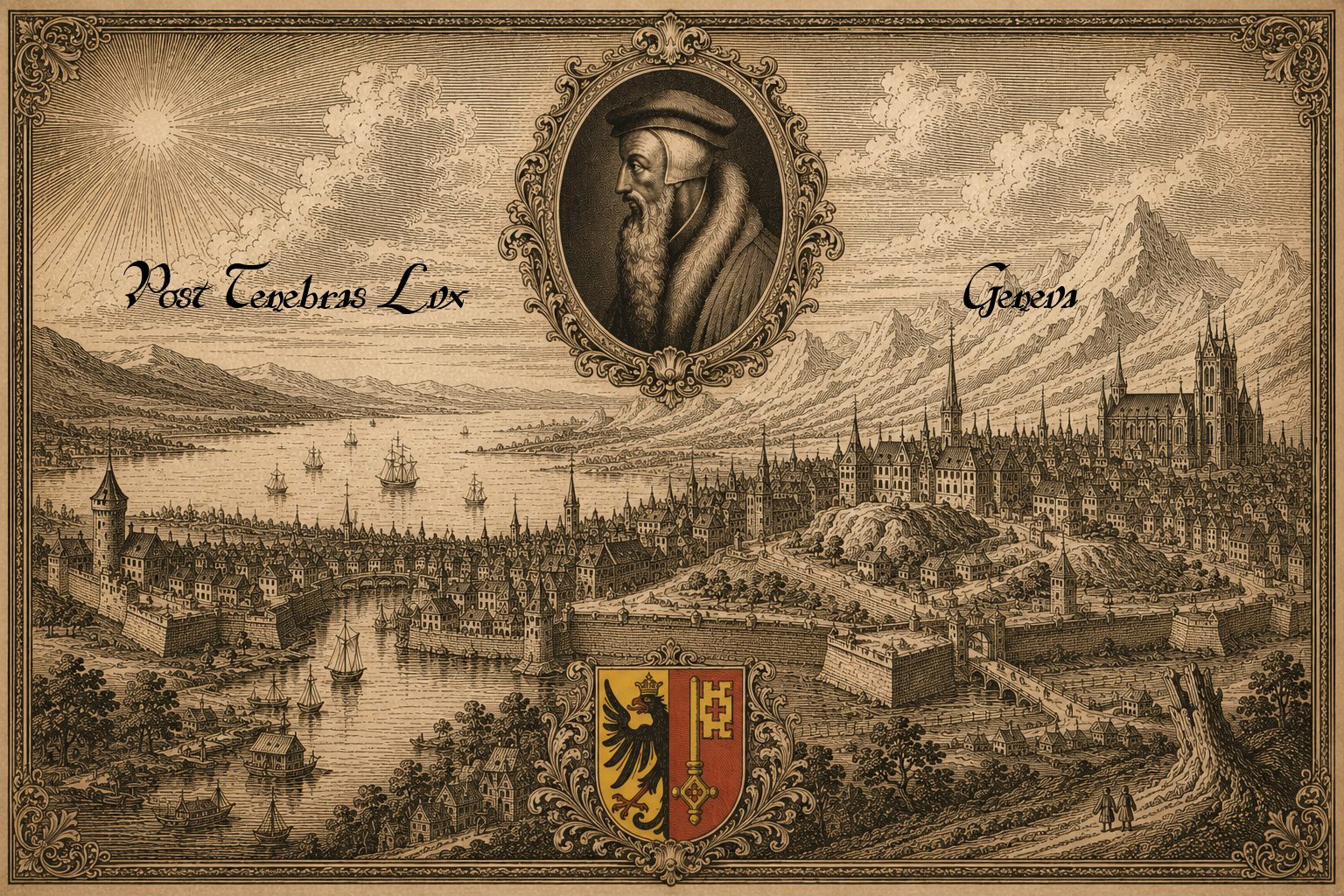
Geneva: The Refugee City and Its Discipline
Jean Calvin meant to stay in Geneva for one night. He was a young French scholar traveling toward Strasbourg, forced onto a detour by a war between Francis I and Charles V, and he planned to be gone by morning. Guillaume Farel, the fiery Frenchman who had already spent years dragging Geneva toward reform through argument, expulsion, and sheer persistence, heard that Calvin was in the city and would not let him leave. According to Calvin's own account, Farel threatened him with a curse from God if he refused to stay and help. Calvin stayed — on and off, through one expulsion and one recall — for the rest of his life.
A City Already in Motion
Geneva had not waited for Calvin to become Protestant. In 1536, months before his arrival, the city's General Council had voted to live "according to the Gospel," pushed there by Farel's preaching and by Geneva's political break from the House of Savoy, which had long controlled the city through its allied bishop. What Geneva lacked was not conviction but structure — a workable answer to the question of how a city actually organizes itself around reformed doctrine, day to day, parish to parish.
Calvin's first attempt at supplying that structure was too fast and too rigid for the city's taste. Within two years, a dispute over church discipline and communion practice got both Calvin and Farel expelled from Geneva entirely. Calvin spent the next three years in Strasbourg, pastoring a congregation of French refugees under Martin Bucer — an apprenticeship, as it turned out, in exactly the kind of practical church governance Geneva would eventually ask him to return and build.
The Consistory
Recalled to Geneva in 1541, Calvin drafted the Ecclesiastical Ordinances, which created a body called the Consistory: pastors and lay elders meeting weekly to oversee the moral and doctrinal life of the city, with the power to summon citizens, investigate complaints, and — for serious or repeated offenses — refer cases to the civic magistrates. Its business ranged from doctrinal disputes down to marital quarrels and drunkenness, and its surviving registers are one of the richest windows historians have into ordinary life in a Reformation city.
The Consistory's reputation, in later centuries, hardened into caricature — a theocracy policing private morals. The archival record is more mixed: most sessions dealt with reconciling neighbors and spouses rather than punishing heretics, and excommunication was used sparingly. But the Consistory's authority was real, and it made Geneva's church, for a time, more tightly interwoven with civic life than Zürich's or Basel's.
The Institutes and the Academy
Calvin's theological reputation rested less on Geneva's institutions than on a single book: the Institutes of the Christian Religion, first published in 1536 as a short defense of reformed belief and expanded across four editions into the era's most systematic statement of Reformed theology. In 1559 Calvin added an Academy to the city, training pastors who would carry Geneva's version of the Reformation to France, Scotland, the Netherlands, and beyond — which is how a city of roughly thirteen thousand people came to shape Protestant churches across an entire continent.
"The most perfect school of Christ that ever was in the earth since the days of the apostles" — John Knox's verdict on the Geneva he found in exile.
A City of Refugees
Much of that influence traveled through people rather than print. Geneva's population swelled with religious refugees from France, England, Italy, and Scotland throughout the 1550s, and many returned home once conditions allowed, carrying Geneva's discipline, Geneva's psalter, and Geneva's confidence that a city could be organized entirely around reformed conviction. Calvin died in 1564; the pattern he built outlived him by centuries.